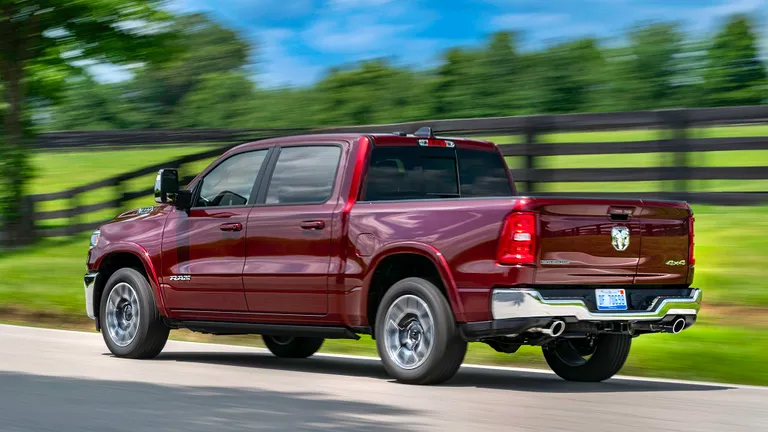
We usually long-term-test a truck the old way: pass the keys around the staff, write it up at the end. This Ram wrote itself up. Nine months wired to DIMO, 3.9 million telemetry rows, every signal stamped and stored. The data desk spent a few days inside the dataset looking for the things the keys-around-the-office approach would never catch. Five things stuck.
— DIMO Data Desk
Our Ram drove on 168 of the 260 days we watched it. The other 92, the engine never started. When the wheels did turn, the truck covered about 40 miles a day on average, and half of all trips were under 16 minutes. Sunday at 3 PM is the busiest hour of the week. That isn't a commuter profile. It's a Costco-and-the-occasional-cross-state-haul profile.
Worth sitting with, because our Laramie is optioned heavy: Trailer Tow Group, Hands-Free Active Driving Assist, Advanced Safety II, air suspension, Laramie Level 2, leather buckets, multi-function tailgate. As-tested near $77K. That's a lot of half-ton sitting in a driveway 92 days a year, plus another however-many waiting for Sunday afternoon. The most expensive parking space in the household, by some margin.
The five biggest driving days all sit inside Thanksgiving and Christmas. Dec 21 alone — the 781-mile interstate haul we replay on the home page — moved our Laramie 7.5% of its annual mileage in a single calendar day. Strip those five days out and the truck collapses into a local errand vehicle that happens to weigh five-and-a-half thousand pounds.
The buying question hiding under this is the one no window sticker is going to answer for you: how many days a year does the truck need to be a truck? For our owner, the honest answer was five. The other 258 days, almost anything with four wheels would have moved the same people and the same stuff — a Ford Maverick for a fraction of the gas, or the family sedan when the boat wasn't involved.
A 17% gap between EPA combined and observed lifetime is exactly what you'd expect from a Hurricane I-6 driven the way ours was: lots of suburban stop-and-go, a Michigan winter, a real towing weekend in October. The ground truth is the owner's hand-kept pump-receipt log: 16.57 mpg. The lab number is a ceiling, not an average. The conventional wisdom would have put a Hemi V-8 on the same routes in the 12–14 range, so the Hurricane is genuinely more efficient — just not EPA-sticker efficient.
DIMO's telemetry put it at 15.77 mpg, within ~5% of the receipts. Nearly all of that gap is distance: the dongle's odometer signal comes in 10-second snapshots and runs a few percent short of the dashboard, while the gauge-derived gallons land within about 1% of what the pump actually dispensed.
The honest figure, at the $3.12/gal the owner actually paid: $1,954 in fuel to move 10,645 miles. About 19 cents per mile, fuel only, before tires, brake pads, or whatever the dealer will eventually say about the brake-rotor wear that's coming.
Detroit, nine months, seventy-seven cold-soaked starts. The coldest morning we recorded was three degrees Fahrenheit ambient, with the engine block at negative sixteen Celsius. Cabin to operating temperature in three minutes twenty-two seconds. By any honest measure, this is the climate the remote-start feature was specced for.
The owner used it twelve times. Once every twenty-two days, in the part of the country where remote-start is one of the headline reasons salesmen tick the Laramie box for you. When the brochure tells you remote-start is the cold-weather reason to buy this thing, the lived answer here was twelve.
Four-and-a-half hard-brake events per trip is more than I'd expect from a careful driver. Plot the events on the map though and the pattern stops being mysterious: they cluster at the same Detroit-area intersections any local could name without looking. Not the truck, not the driver — the geography.
The other number that sticks is the top observed speed: 103 mph, once, in 263 days. The dataset records when it happened and where, and not much else. Whether that was ten over on an empty stretch of I-75 or a fast pass around a semi, we know it happened, we know when. That level of resolution about your own driving is the kind of thing very few of us have in our lives.
After nine months of reading the truck's own sensor data, the thing I keep coming back to isn't a number. It's how rarely the truck-ness of this truck actually got cashed in. The Ram drove the way a loaded half-ton's spec sheet warns it will: heavy, thirsty, optioned to the gills. Five days of real haul work, 258 days of being a $77K errand vehicle. That isn't an indictment of this truck. It's something to know before you sign the same option list.
If you're cross-shopping a Laramie, the most useful number in your conversation won't be on the window sticker. It's the answer to "how many days a year do I need this to be a truck?" If yours is a lot, the Ram is going to give you a comfortable, capable place to be. If yours is a handful, a Maverick or a Santa Cruz will move you and your stuff with less drama at the pump, and you can rent capability the four times you actually need it.
Nine months of telemetry settled this for our owner. Most owners don't have that. Most owners are going to have it.